Do house mice carry hantavirus? This is one of the most common questions people ask when they discover rodent activity in their homes. The short answer is that common house mice (Mus musculus) are generally NOT carriers of hantaviruses that cause disease in humans. However, other mouse species that may look similar can be deadly carriers.
This article explains which rodents carry hantavirus, how to identify different mouse species, and what precautions you should take regardless of the rodent type, based on guidance from the Centers for Disease Control and Prevention and World Health Organization.
The Short Answer: House Mice and Hantavirus
Common house mice (Mus musculus) are not considered significant carriers of hantaviruses that cause disease in North America or Europe. This is important but potentially misleading information because:
- Other mice that enter homes CAN carry deadly hantaviruses
- Distinguishing mouse species is difficult for non-experts
- All wild rodent contact should be treated as potentially dangerous
- House mice can carry other diseases
Understanding what hantavirus is helps explain why certain rodent species are carriers while others are not.
Which Rodents Actually Carry Hantavirus?
Specific rodent species serve as natural reservoirs for different hantavirus strains:
| Rodent Species | Common Name | Hantavirus Strain | Disease | Geographic Region |
|---|---|---|---|---|
| Peromyscus maniculatus | Deer mouse | Sin Nombre | HPS | North America |
| Peromyscus leucopus | White-footed mouse | New York virus | HPS | Eastern North America |
| Sigmodon hispidus | Cotton rat | Black Creek Canal | HPS | Southeastern USA |
| Oryzomys palustris | Rice rat | Bayou virus | HPS | Gulf Coast USA |
| Oligoryzomys longicaudatus | Long-tailed pygmy rice rat | Andes virus | HPS | South America |
| Apodemus agrarius | Striped field mouse | Hantaan virus | HFRS | Asia |
| Myodes glareolus | Bank vole | Puumala virus | HFRS | Europe |
| Rattus norvegicus | Norway rat | Seoul virus | HFRS | Worldwide |
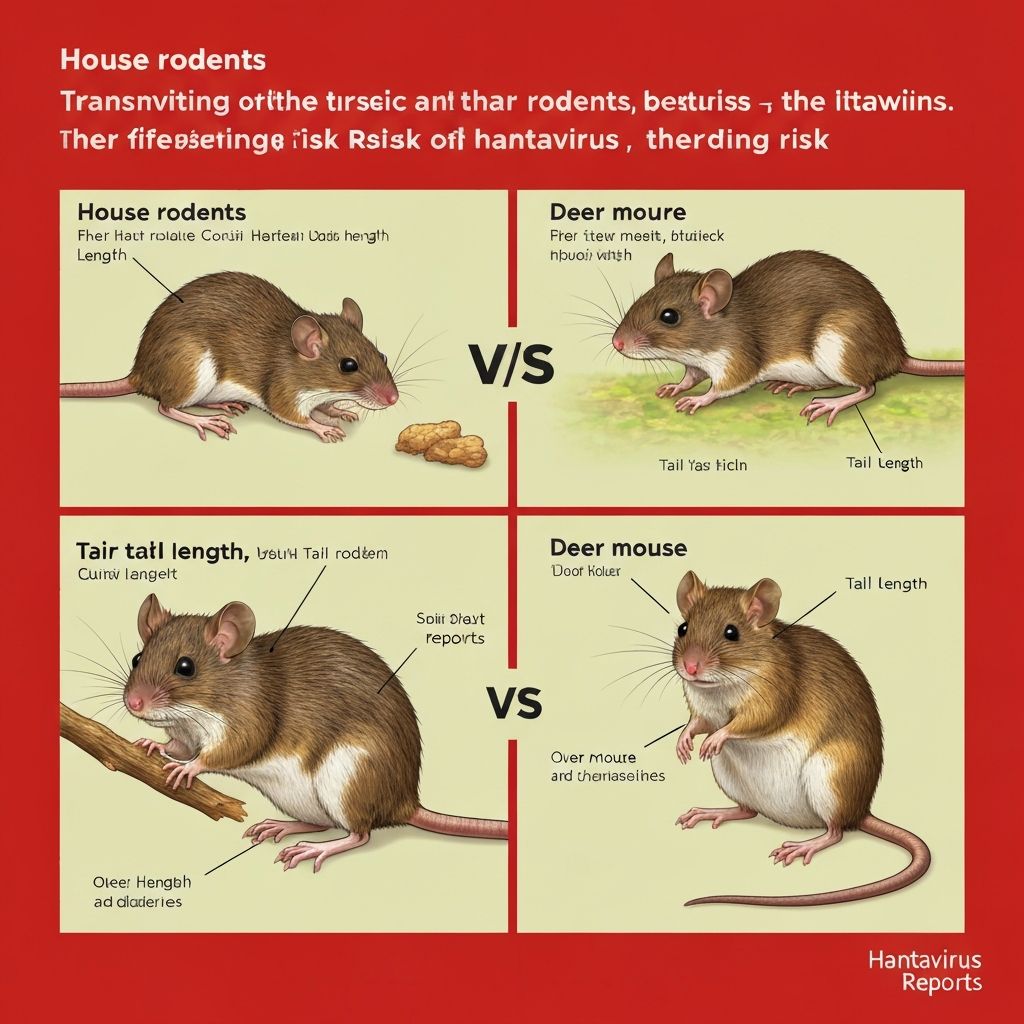
House Mouse vs. Deer Mouse: Key Differences
Since deer mice commonly enter homes and can be confused with house mice, knowing the differences is crucial:
| Feature | House Mouse (Mus musculus) | Deer Mouse (Peromyscus maniculatus) |
|---|---|---|
| Body color | Uniform gray or brown | Brown/tan back, white belly |
| Belly color | Gray (same as back) | Distinctly white |
| Tail | Uniform color, scaly | Bicolored (dark top, light bottom) |
| Ears | Small, dark | Large, may have light edges |
| Eyes | Small, dark | Large, prominent |
| Feet | Gray/brown | White |
| Body length | 3-4 inches | 3-4 inches |
| Habitat preference | Human structures | Fields, forests, sometimes buildings |
Visual Identification Tips
The most reliable ways to distinguish these species:
- Belly color: The deer mouse has a sharply defined white belly, while house mice have gray bellies
- Tail: Deer mouse tails are distinctly two-toned; house mouse tails are uniform
- Feet: Deer mice have white feet; house mice have darker feet
However, identification can be challenging, especially with young mice or poor lighting. When in doubt, treat all wild mice as potentially dangerous.
Why House Mice Are Lower Risk
House mice have coexisted with humans for thousands of years and have adapted to indoor environments. Several factors explain their lower hantavirus risk:
Evolutionary History
- House mice evolved primarily in human-associated environments
- They have limited contact with wild hantavirus-carrying rodent populations
- Their immune systems and the viruses they carry differ from wild rodent populations
Habitat Differences
- House mice prefer indoor environments year-round
- Deer mice primarily live outdoors but enter buildings seasonally
- Limited overlap reduces cross-species virus transmission
Important Caveats
While house mice are lower risk for hantavirus, they still pose health concerns:
- Can carry other diseases (salmonella, lymphocytic choriomeningitis)
- May contaminate food and surfaces
- Can cause property damage
- Should still be controlled and handled safely
The Deer Mouse: Primary Hantavirus Carrier
The deer mouse deserves special attention as the main hantavirus vector in North America:
Where Deer Mice Live
- Woodlands and grasslands
- Rural and semi-rural areas
- Outbuildings (sheds, barns, cabins)
- Occasionally enter homes, especially in fall/winter
When Deer Mice Enter Homes
Seasonal patterns affect human exposure risk:
| Season | Deer Mouse Behavior | Human Risk |
|---|---|---|
| Spring | Active outdoors, breeding | Moderate (outdoor activities) |
| Summer | Peak outdoor activity | Higher (camping, hiking) |
| Fall | Seeking shelter indoors | Higher (entering buildings) |
| Winter | May nest in structures | Moderate (cleaning closed buildings) |
Other Rodents in Your Home: Risk Assessment
Various rodents may enter homes. Here is a risk assessment:
| Rodent | Hantavirus Risk | Other Disease Risk | Common in Homes |
|---|---|---|---|
| House mouse | Very low | Moderate | Very common |
| Deer mouse | High | Low | Occasional |
| White-footed mouse | High | Low (also carries Lyme) | Occasional |
| Norway rat | Moderate (Seoul virus) | High | Common in some areas |
| Roof rat | Low | High | Common in some areas |
| Voles | Low to moderate | Low | Rare indoors |
What If You Cannot Identify the Mouse Species?
When you find mice or mouse droppings and cannot determine the species:
Assume the Worst
- Treat all wild mouse droppings as potentially infectious
- Follow safe cleanup procedures regardless of species
- Do not attempt to catch or handle mice directly
Safe Cleanup Protocol
When cleaning areas with mouse activity:
- Ventilate the space for at least 30 minutes
- Never sweep or vacuum droppings (creates dangerous aerosols)
- Wear rubber or plastic gloves
- Spray contaminated areas with disinfectant or 10% bleach solution
- Wait 5-10 minutes before cleaning
- Use damp mopping methods only
- Double-bag all waste materials
- Wash hands thoroughly afterward
When to Seek Professional Help
Consider professional pest control when:
- Large infestations are present
- You cannot identify entry points
- Rodents persist despite DIY efforts
- You are uncomfortable handling the situation
- The property has been vacant and heavily contaminated
Regional Considerations
Hantavirus risk varies by location. Check our interactive map and statistics dashboard for regional data.
North America
- Deer mice are present throughout most of the continent
- Highest HPS case rates in southwestern USA (Four Corners region)
- Rural areas have higher risk than urban centers
- House mice in cities pose minimal hantavirus risk
Europe
- Bank voles carry Puumala virus (causes mild HFRS)
- House mice remain low risk
- Scandinavian countries have highest case rates
- Risk increases in forested areas
Asia
- Multiple hantavirus strains present
- Field mice and rats are primary carriers
- Urban areas can have Seoul virus risk (Norway rats)
- House mice remain lower risk than wild species
Protecting Your Home from All Rodents
Regardless of species, keeping all rodents out protects your health:
Exclusion Methods
- Seal all gaps larger than 1/4 inch (6mm)
- Install door sweeps on exterior doors
- Cover vents with metal mesh
- Repair holes in walls and foundations
- Check where utilities enter buildings
Habitat Reduction
- Store food in sealed containers
- Keep garbage in rodent-proof bins
- Remove outdoor food sources (bird feeders, pet food)
- Clear vegetation near buildings
- Eliminate wood piles and debris near structures
Population Control
- Use snap traps for immediate removal
- Place traps along walls where rodents travel
- Check and reset traps regularly
- Consider professional pest control for persistent problems
Signs of Different Rodent Species
Identifying which rodents are present helps assess risk:
| Sign | House Mouse | Deer Mouse | Rat |
|---|---|---|---|
| Droppings size | 1/4 inch | 1/4 inch | 1/2-3/4 inch |
| Droppings shape | Pointed ends | Pointed ends | Blunt ends |
| Gnaw marks | Small | Small | Larger |
| Nesting material | Paper, fabric | Outdoor materials, seeds | Various |
| Tracks | Small (4 toes front, 5 back) | Small | Larger |
Frequently Asked Questions
Can I get hantavirus from a pet mouse?
Pet mice from reputable breeders are bred in controlled environments and are extremely unlikely to carry hantavirus. However, wild-caught mice or those from unknown sources could potentially carry the virus. Only purchase pets from established, reputable sources.
Do mice in city apartments carry hantavirus?
Urban house mice have very low hantavirus risk. The primary carriers (deer mice, white-footed mice) prefer rural and semi-rural environments. However, standard hygiene precautions should still apply when dealing with any rodent infestation.
Should I be worried if I see one mouse in my house?
One mouse usually indicates more are present. While a single house mouse poses minimal hantavirus risk, you should still address the infestation to prevent population growth and other health/property concerns. Implement exclusion and control measures promptly.
Can my cat bring home a mouse that carries hantavirus?
Yes. Cats that hunt outdoors may catch deer mice or other hantavirus carriers. Handle any rodent your cat brings home with gloves, and dispose of it safely. While the risk of transmission from a dead mouse is lower, caution is warranted.
How do I know if I have deer mice or house mice?
Look for the distinguishing features: deer mice have white bellies and feet with bicolored tails, while house mice are uniformly gray/brown. If uncertain, treat the infestation as high-risk and follow all safety precautions.
What to Do If You Have Been Exposed
If you have had contact with rodents or their droppings:
1. Do not panic: Most rodent encounters do not result in hantavirus
2. Note the circumstances: Document when, where, and how exposure occurred
3. Monitor for symptoms: Watch for fever, muscle aches, fatigue for up to 8 weeks
4. Seek medical care: If symptoms develop, especially breathing difficulty
Learn about warning signs in our hantavirus symptoms guide and available treatment options.
Conclusion
While common house mice (Mus musculus) are generally not carriers of hantaviruses that cause human disease, other mouse species that enter homes can be deadly carriers. The deer mouse, in particular, is responsible for most hantavirus cases in North America.
Key takeaways:
- House mice pose minimal hantavirus risk but carry other diseases
- Deer mice and white-footed mice are the primary hantavirus carriers in North America
- When in doubt about species identification, treat all wild mice as potentially dangerous
- Follow safe cleanup procedures regardless of mouse species
- Prevent rodent entry through exclusion and habitat management
Stay informed about hantavirus by following our latest news and exploring our in-depth articles.
*This article is for informational purposes only and does not constitute medical advice. If you suspect hantavirus exposure, seek immediate medical attention. Information sourced from WHO, CDC, and peer-reviewed scientific literature.*